
Ground Bond Testing to IEC 60335-1 on an Appliance Production Line
A ground bond test passes a high current, typically between 10 A and 40 A, through the protective earth path of an appliance and measures the resistance of that path. It proves the earth conductor can carry real fault current, which a low-current continuity check cannot.
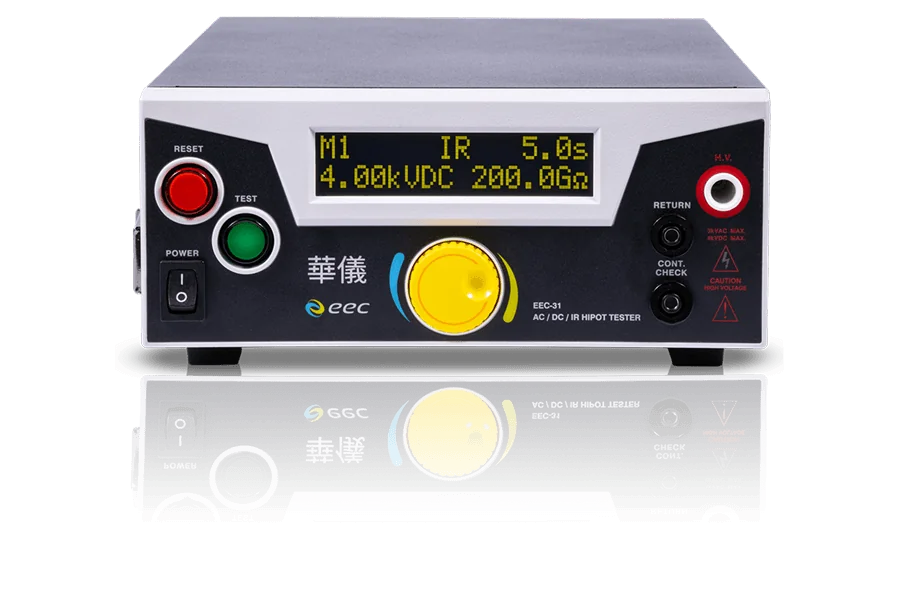
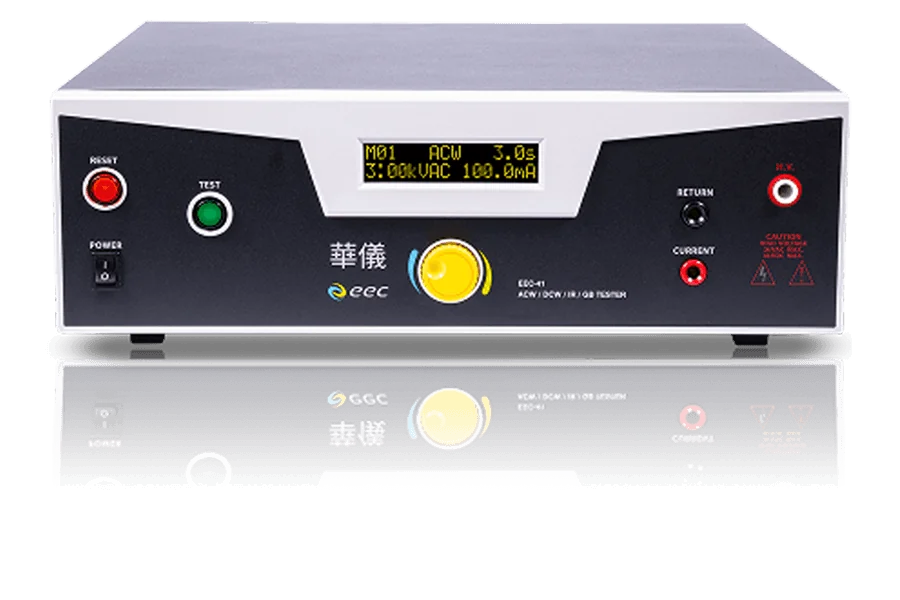
EEC Huayi builds this test into the EEC-41 4-in-1 hipot tester, which runs ground bond alongside AC withstand, DC withstand, and insulation resistance for appliance manufacturers across Southeast Asia. If your line ships Class I appliances, you are already running some form of earth path verification on every unit. It is worth checking whether the test you run today would satisfy an auditor reading IEC 60335-1 closely, and whether it needs its own instrument to do so.
What Does a Ground Bond Test Actually Prove?
A ground bond test verifies that the earth conductor can survive the current a real fault would push through it. The tester forces a current far above normal operating levels between the earth pin and the accessible metal parts of the appliance, then calculates resistance from the voltage drop across the path.
Why does the high current matter? A fault inside a Class I appliance sends current through the earth path for as long as the fuse or breaker takes to open, and the conductor has to survive that without burning through. In production testing the ground bond test typically applies 25 to 40 A and checks that the resistance of the path stays below a set limit, normally 100 mΩ, as described in In Compliance Magazine’s article on ensuring connectivity during product safety testing. A passing result proves both that the path exists and that it can carry the current it was designed for.
The Continuity Check Shortcut, and Why Auditors Reject It
A multimeter or a simple buzzer-type continuity checker applies a small current, often milliamps. It will happily pass a crimped terminal, a partly broken conductor, or a single surviving strand of wire, because a poor joint still conducts at low current. Under fault conditions that same joint heats, burns open, and leaves the chassis live.
This is the compliance gap we see most often on appliance lines. The station has an earth check, the check passes every unit, and yet it does not meet the routine test values given in the standard because the current is too low. If your earth path verification runs below 10 A, it’s a continuity check, not a ground bond test.
What Does IEC 60335-1 Require for Appliances?
IEC 60335-1:2020, the general safety standard for household and similar appliances, specifies earth path testing twice: once as a type test for certification, and again as a routine test on every production unit. The two use different values, and mixing them up is a common audit finding.
National certification schemes across Southeast Asia, including SIRIM in Malaysia, TISI in Thailand, and SNI in Indonesia, certify appliances against their national adoptions of IEC 60335-1, so these requirements follow your product into each market.
Type Test vs Routine Production Test for IEC 60335-1
| Type test (clause 27.5) | Routine test (Annex A) | |
|---|---|---|
| When it runs | During certification or design verification | On 100% of production units before shipment |
| Test current | 25 A, or 1.5 times rated current if that is higher | Not less than 10 A |
| Source voltage | No-load voltage not exceeding 12 V | No-load voltage not exceeding 12 V |
| Resistance limit | 0.1 Ω maximum | Set by the standard and product type; commonly 0.1 Ω, or 0.2 Ω where the supply cord is included in the measurement |
| Typical duration | Long enough for a stable reading | Short dwell suited to line speed |
Your certification agency’s test specification takes precedence over this table, and the Part 2 standard for your product category can modify the general values. Check both before you set up a station. One nuance worth knowing: clause 27.5 sits in the normative body of the standard, while Annex A is informative. It is your certification body that makes the routine tests binding, as a condition of holding the license and mark, which is why auditors check them. And treat the routine test as its own requirement rather than a lighter copy of the type test; the current and limits differ for a reason.
Which Appliances Need It: Class I, II, and III
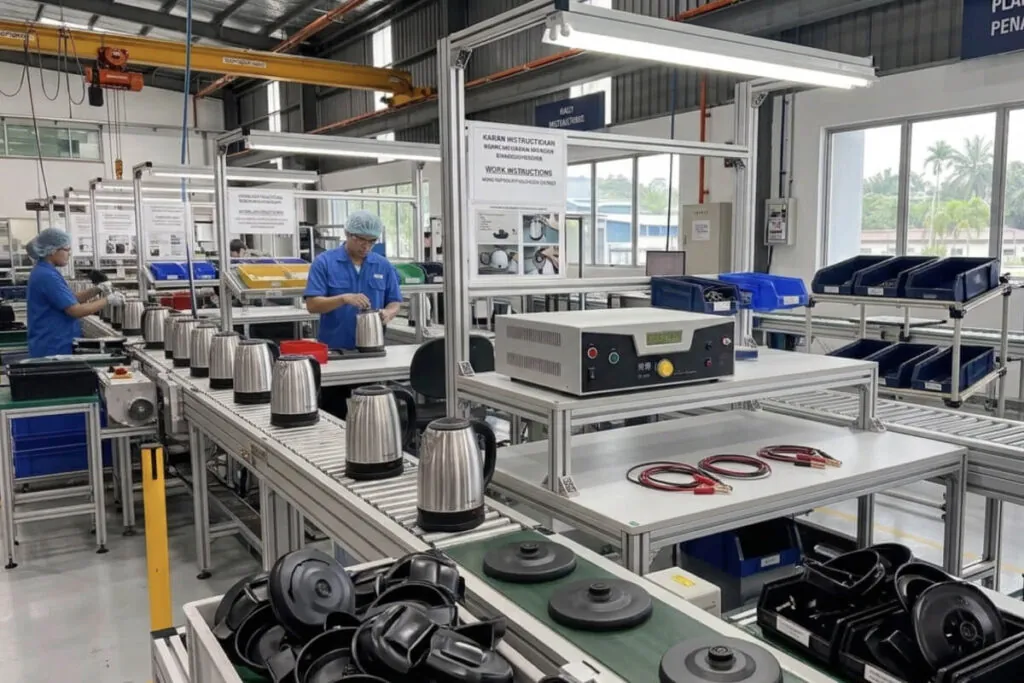
Class I appliances rely on the protective earth as a safety measure, so they need the ground bond test. That covers most appliances with a metal enclosure or an earthed plug: kettles, rice cookers, washing machines, refrigerators, air conditioners, and similar products.
Class II (double insulated, the square-in-square symbol) and Class III (supplied at safety extra-low voltage) appliances have no protective earth to test, so the requirement does not apply. Contract manufacturers running mixed Class I and Class II products on one line tend to store separate sequences, with the ground bond step included for Class I models only. The EEC-41 holds three test memories, enough to cover the active product changeovers on a typical appliance station.
Can One Instrument Run Ground Bond and Hipot?
Yes, and for most appliance lines that is now the sensible configuration. The traditional setup pairs a hipot tester with a dedicated ground bond tester, which means two instruments to buy and calibrate plus an extra mount-and-unmount cycle on every unit tested. A 4-in-1 instrument removes the second machine.
The EEC-41 runs ground bond from 1.0 to 32.0 A, which covers the 10 A routine test and the 25 A type test current with margin, alongside ACW, DCW, and IR in a single MYR 4,615 unit. For choosing between the AC and DC withstand methods on that same station, see our guide to AC and DC hipot and IR test selection.
Keeping the Test Simple for New Operators
Appliance production in Southeast Asia often runs rotating shifts, and the test station cannot depend on one experienced technician. This should shape your equipment choice as much as the specifications do.
On the EEC-41, the validated setup for a product sits in one of the three stored test memories. A new operator recalls the memory, connects the unit, and starts the test; operators can be trained in minutes because there is nothing to configure at the station. Supervisors who want to go further can lock the setup entirely using the security modes covered in our article on PLC remote control for hipot testers, which also shows how to wire pass and fail outputs to indicator lights so results can’t be misread.
If you are newer to safety testing as a whole, our overview of electrical safety testing in manufacturing covers where ground bond sits among the four core tests.
Frequently Asked Questions
What is the difference between a ground bond test and a ground continuity test?
A ground continuity test applies a small current, often milliamps, and only confirms that a conductive path exists between the earth pin and the chassis. A ground bond test applies 10 A or more through the same path and measures its resistance, proving the conductor can actually carry fault current. Continuity alone does not meet the routine test values given in IEC 60335-1.
What test current does IEC 60335-1 require for the earth path?
The type test in clause 27.5 of IEC 60335-1 uses 25 A, or 1.5 times rated current if that is higher, from a source not exceeding 12 V, with a resistance limit of 0.1 Ω. The routine production test in Annex A uses a current of not less than 10 A. The Part 2 standard for a specific product category can modify these values.
Do Class II appliances need a ground bond test?
No. Class II appliances are double insulated and have no protective earth conductor, so there is nothing to test. The requirement applies to Class I appliances, which rely on an earthed chassis as a safety measure. Mixed production lines typically store separate test sequences for Class I and Class II models.
Can the EEC-41 run ground bond and hipot tests on the same unit?
Yes. The EEC-41 is a 4-in-1 electrical safety tester covering ground bond from 1.0 to 32.0 A together with AC withstand, DC withstand, and insulation resistance. One instrument runs all required tests on a Class I appliance in a single mounting, replacing a separate hipot tester and ground bond tester.
Is ground bond testing required on every production unit?
For Class I appliances certified to IEC 60335-1 and its national adoptions, yes in practice. Annex A of the standard describes earthing continuity as a routine test performed on 100% of production before shipment, and certification bodies make this binding as a condition of the product license. Certification schemes in Southeast Asia audit against it.
Not sure whether your current earth check meets the routine test requirement? Ask our application engineers to review your test setup against your certification agency’s specification.