
PLC Control for Hipot Testers – How Remote Control Improves Production Line Testing
If you run hipot tests by hand, with an operator holding probes against each unit, you are paying for it in three ways: slow throughput, inconsistent results, and an operator working close to high voltage. PLC control fixes all three, and it does so without the cost of a PC-based test system.
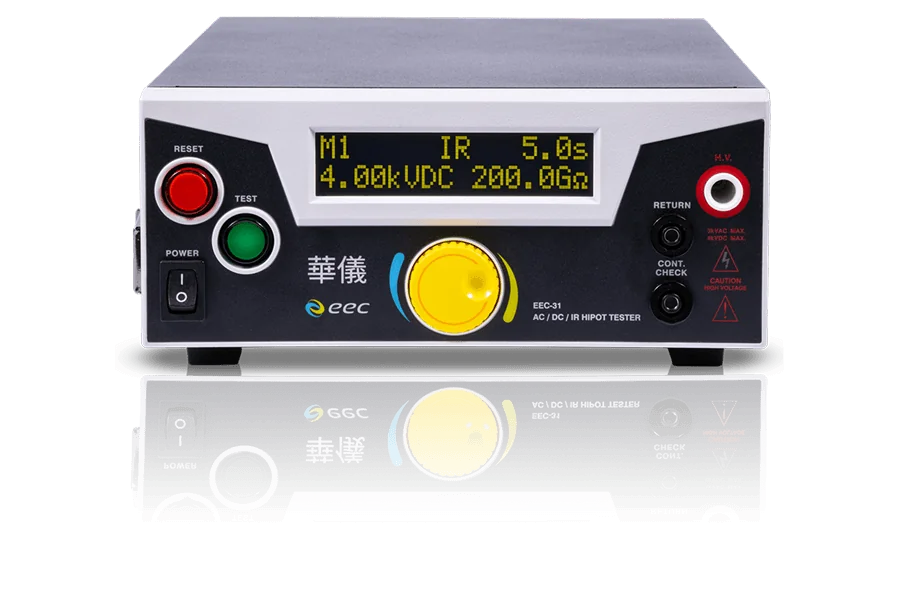
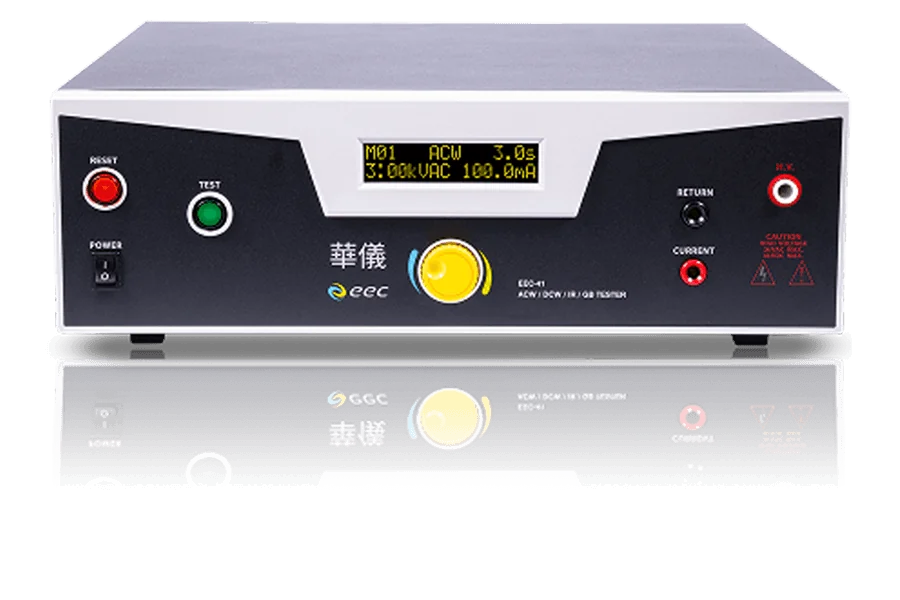
PLC control is the simplest form of remote control on a hipot tester. It lets you trigger a test with a footswitch or palm switch, send pass and fail results to indicator lights, and wire in an interlock that cuts the high voltage the moment a guard opens. Both EEC Huayi testers, the EEC-31 and the EEC-41, support PLC remote control.
What Is PLC Control on a Hipot Tester?
PLC stands for Programmable Logic Control. On a hipot tester it is a form of relay-based automation that lets an external switch or controller run the device. You do not need to write any computer code to set it up, you are working with simple switches and signals rather than software.
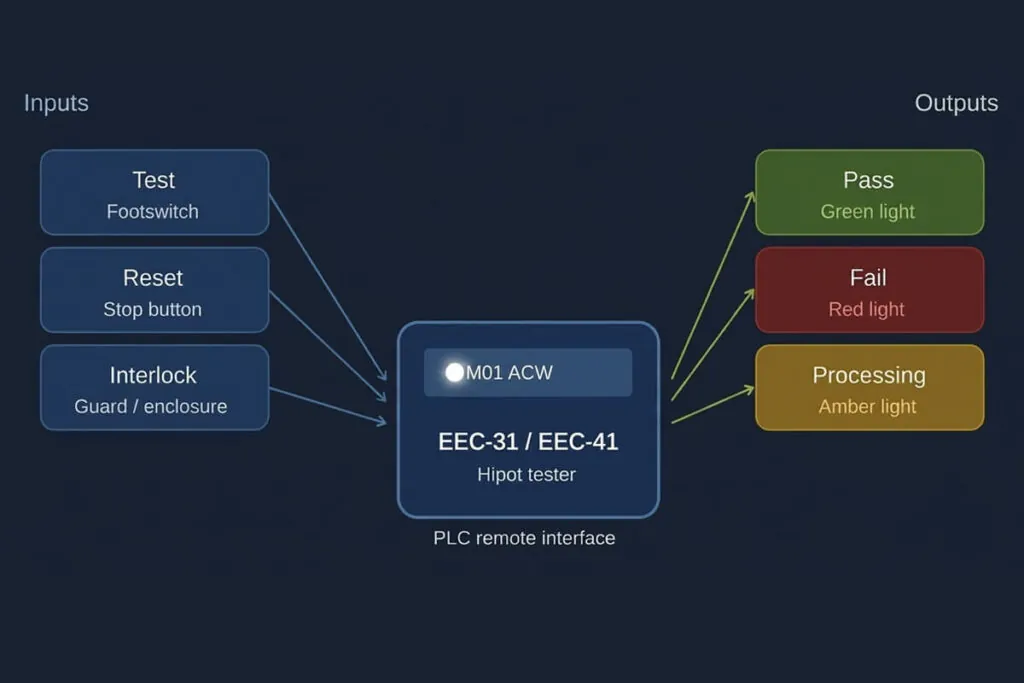
A PLC connection gives you a standard set of controls. On the input side, you send the tester three signals: Test to start, Reset to stop or clear, and Interlock, a safety circuit that has to stay closed for a test to run. On the output side, the tester sends three back: Pass, Fail, and Processing, which tells you a test is underway.
Each output works by switching a relay, so you can connect it to whatever suits your station, a light, a buzzer, or a line controller. That flexibility is the advantage: you decide how the station signals start, stop, and the result. The EEC-31 and EEC-41 both provide these inputs and outputs through their PLC remote interface.
PLC Remote Control Signals (EEC-31 and EEC-41)
| Direction | Signal | Function |
|---|---|---|
| Input | Test | Starts a test cycle on the tester. |
| Input | Reset | Stops a test in progress or clears the current result. |
| Input | Interlock | Safety circuit that must stay closed for high voltage to be applied. If it opens, the tester stops at once. |
| Output | Pass | Signals that the device under test passed the test. |
| Output | Fail | Signals that the device under test failed the test. |
| Output | Processing | Signals that a test is currently underway. |
Higher Throughput Without Manual Probing
An operator holding probes against each device under test (DUT) is slow, hard to repeat, and working far too close to high voltage; PLC control removes these issues from the testing cycle.
Instead of reaching into the test area, the operator places the DUT and starts the test with a footswitch or palm switch. The tester runs the stored test and reports the result through its Pass and Fail outputs, which you can wire to a green and a red light. The operator reads the result, removes the tested unit and loads the next one which is a much more efficient and safe operational procedure than manual testing on a busy production line.
The shorter your test, the more benefits you reap from PLC control. Production hipot tests often run for just one to two seconds per unit, so a second saved on each manual action turns into significant time saving in high volume production environments. The EEC-31 is built for exactly this kind of repetitive production testing, with a simple interface that keeps the cycle fast and steady no matter who is running the tests.
Safer Operation Around High Voltage
Safety is the one of the strongest reasons to use PLC control, and this is due to the Interlock input. The interlock is a safety circuit that has to stay closed for the tester to apply high voltage. The moment it opens, the tester stops a test in progress or refuses to start another one.
You wire that interlock to a physical guard, so high voltage can never be live while an operator can reach the DUT. Manufacturers do this in a few common ways:
- An interlocked enclosure puts the DUT inside a cover, and opening the cover cuts the voltage.
- A light curtain places an infrared beam between the operator and the DUT, so breaking the beam cuts the voltage at once.
- Dual palm switches require both of the operator’s hands to hold down switches for the test to run, which keeps both hands clear of the DUT.
On longer tests, operators tend to find ways around palm switches, which defeats the protection. When test times are long, an interlocked enclosure or a light curtain is the more reliable choice. The EEC-41 is a rack-mount unit that drops straight into this kind of guarded station, so you can build a safe, enclosed cell around it.
The EEC-31 and EEC-41 are both built to comply with IEC 61010-1 the safety standard for electrical test and measurement equipment.
Fewer Errors and More Consistent Results
Manual testing leaves room for mistakes such as the wrong test being selected, skipping steps in the process, or the dwell time varying from one operator to the next. PLC control resolves this by running a fixed, stored test the same way on every cycle.
The EEC-31 and EEC-41 each hold three test memories, so a saved setup runs identically every time rather than being keyed in by hand. Both also include Run Only and Memory Lock security, which stops an operator from changing a saved test on the floor. The test you validated stays the test that actually runs. If what you need is reliable, repeatable triggering without that overhead, PLC control on the EEC-31 or EEC-41 covers it at a lower cost.
Frequently Asked Questions
Does the EEC-31 support PLC remote control?
Yes. Both the EEC-31 and the EEC-41 include PLC remote control as standard. This gives you Test, Reset, and Interlock inputs and Pass, Fail, and Processing outputs, so you can automate triggering and result signaling without a PC.
Is PLC control the same as PC or software control?
No. PLC control is relay-based and uses simple switches and signals, with no computer programming needed. PC or software control runs the tester from a connected computer and can add features like data logging. The EEC-31 and EEC-41 provide PLC remote control, not software control.
What is the interlock and why does it matter?
The interlock is a safety input that must stay closed for the tester to apply high voltage. If it opens, the tester cuts the voltage at once. Wiring it to an enclosure cover or a light curtain keeps high voltage off whenever an operator can reach the device under test. This is the main operator-safety benefit of PLC control.
Can I build the EEC-41 into an automated test station?
Yes. The EEC-41 uses its PLC inputs and outputs to connect to footswitches, palm switches, light curtains, or a line controller. As an interlock station ready 4-in-1 unit covering ACW, DCW, IR, and ground bond, it fits a single guarded cell that runs the full safety test sequence.
Make the Most of Your Hipot Tester
PLC control turns a standalone hipot tester into a faster, safer, more consistent part of your production line, and it does so without the cost or complexity of a PC-based system. The EEC-31 and EEC-41 both include PLC remote control, three test memories, and Run Only and Memory Lock security, and both are CE certified and IEC compliant.
For help specifying a PLC-controlled test station for your production line, please contact us.