
Do You Require a Hipot Tester with Ground Bond on Your Appliance Line?
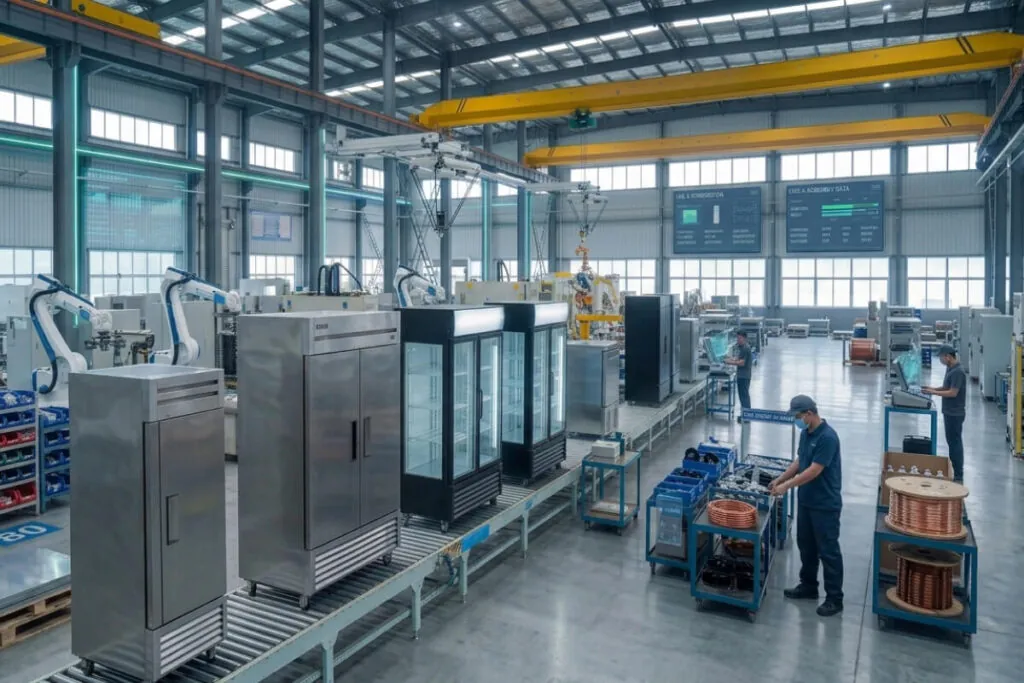
A hipot tester with ground bond is necessary when a production line ships Class I appliances, because their protective earth path must pass a routine high-current test. Production lines manufacturing only double-insulated Class II products can use a 3-in-1 tester covering ACW, DCW, and IR, as they do not require the ground bond function.
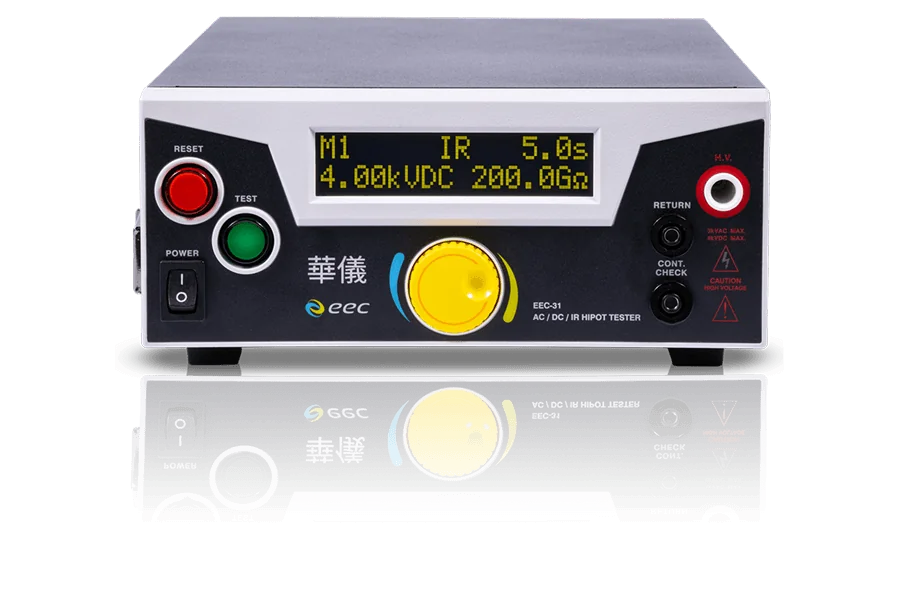
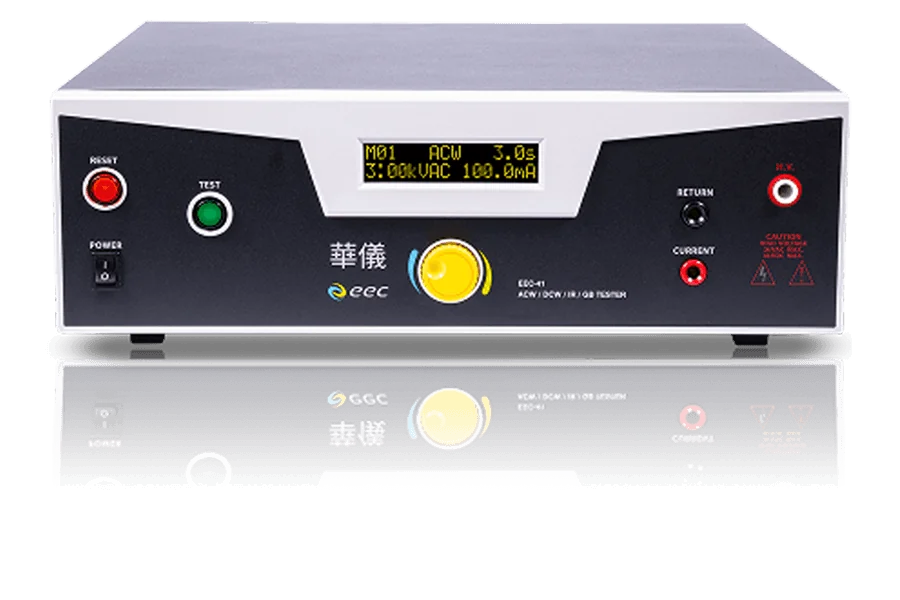
EEC Huayi builds a hipot tester for each type of appliance line. The EEC-31 3-in-1 hipot tester covers AC withstand, DC withstand, and insulation resistance at $899 USD, while the EEC-41 4-in-1 hipot tester adds ground bond at $2,099 USD (prices as of August 2026). This article helps you to select the correct model for your specific requirements.
Ground Bond Determines Which Model You Need
The choice between the two hipot tester models is determined by whether any product on your line carries a protective earth. If it does, the earth path needs a high-current ground bond test as part of routine production, and that requires the EEC-41. Our article on ground bond testing to IEC 60335-1 covers what the test proves and the values the standard sets, so you can find full information on the standards there.
Verify Your Certification Agency’s Test Specification
Your certification agency’s test specification lists every test your products must pass, so it is the first document to check before ordering. If you are manufacturing for other brands, you should verify the test specifications provided by the brands align with the required official certifications. In Compliance Magazine notes in its overview of production hipot testing, that plug-connected devices are subjected to ground tests where the applicable standard requires them, and production units are 100% tested against that specification. If ground bond appears anywhere in that document, the EEC-31 cannot run your full sequence and you need to select the EEC-41.
But if your products are all Class II, paying for a ground bond source you’ll never connect makes little sense. The EEC-31 covers the three tests a double-insulated appliance actually needs, at a much lower price.
How Do the EEC-31 and EEC-41 Specifications Compare?
The two models share the same test logic and differ in output capacity, form factor, and the ground bond function itself.
| EEC-31 | EEC-41 | |
|---|---|---|
| Test functions | ACW, DCW, IR | ACW, DCW, IR, Ground Bond |
| AC Withstand | 3 kV / 10 mA | 3 kV / 100 mA |
| DC Withstand | 4 kV / 5 mA | 4 kV / 5 mA |
| Insulation Resistance | 4 kV / 200 GΩ | 1 kV / 1,000 MΩ |
| Ground Bond | Not available | 1.0 to 32.0 A |
| Dimensions (W × H × D) | 215 × 88.1 × 300 mm | 430 × 132 × 400 mm |
| Weight | 5.46 kg | 24 kg |
| Price (as of August 2026) | $899 USD | $2,099 USD |
Both models are CE certified, support PLC remote control, hold three test memories, include Run Only and Memory Lock security, and carry the 1-year warranty as well as the 45 day money back guarantee.
Heated Appliances Need Higher ACW Current Capacity
The EEC-41 sources up to 100 mA during an AC withstand test compared to the EEC-31’s 10 mA. Appliances with heating elements or long internal wiring tend to draw higher capacitive charging current under AC test voltage, and a tester at its electrical current ceiling can flag a false failure on a healthy unit.
If your product range includes kettles, ovens, rice cookers, or similar heated appliances, the extra current capacity is worth having even before ground bond is considered. For the reasoning behind choosing test methods themselves, see our guide to choosing between AC and DC withstand methods.
Insulation Resistance Test Ranges on the EEC-31 and EEC-41
Routine appliance IR checks typically run at 500 V against a limit of a few megohms, and both models pass that comfortably. The difference only matters at the extremes.
- The EEC-31 measures up to 200 GΩ at 4 kV, which suits manufacturers who also verify components or battery insulation at high resistance.
- The EEC-41 reaches 1,000 MΩ at 1 kV, enough for appliance production.
Benchtop or Fixed Station
At 5.46 kg the EEC-31 moves between benches easily, which suits smaller factories where one hipot tester serves several stations in rotation. The EEC-41 weighs 24 kg in a 430 mm wide format and belongs in a fixed, guarded test station.
Which Hipot Tester Suits a Mixed or Changing Product Range
The EEC-31 cannot be upgraded to run ground bond testing. So although you are manufacturing class II products this year, you could be making class I products next year. If that happens, you would need to purchase another tester at that time. In this case the EEC-41 is the sensible choice.
If you are confident that your requirements will remain the same then the EEC-31 is the better choice at a much lower investment.
Our 45-Day Return Policy Reduces the Risk of Choosing The Wrong Model
The 45-day unconditional return policy covers both models, so a unit that turns out to be the wrong fit for your line can go back within that window. And since both models share the same rotary control and interface, operators will be able to switch to the other model without retraining if you later run both.
Frequently Asked Questions
Which tester do I need for Class I appliances?
The EEC-41. Class I appliances carry a protective earth path that must pass a routine ground bond test under IEC 60335-1 and its national adoptions, and the EEC-41 runs that test from 1.0 to 32.0 A alongside ACW, DCW, and IR.
Where can the EEC-31 and EEC-41 be calibrated?
Professional calibration for both models is available through EEC Huayi and we support warranty work regionally within APAC. Units do not have to be shipped overseas for service or recalibration.
Do the EEC-31 and EEC-41 work the same way for operators?
Yes. Both EEC Huayi models hold three test memories and use the same Run Only and Memory Lock security functions, so an operator trained on one runs the other without additional training. That matters on lines with rotating shifts.
What warranty do the EEC-31 and EEC-41 carry?
Both models carry a 1-year warranty. There is no extended warranty option. Both are also covered by a 45-day unconditional return policy, and professional calibration through EEC Huayi keeps a unit accurate well beyond the warranty period.
Can the EEC-31 and EEC-41 be controlled from a PLC?
Yes. Both EEC Huayi models include PLC remote control, so start, stop, and pass or fail signals can be wired into an automated or semi-automated station. Neither model requires an operator at the front panel once the test sequence is stored.
Send us your certification agency’s test specification and we will confirm which model runs it. Request a quote for the model that fits your line.