
EEC Huayi makes multi-function electrical safety testers for production line engineers and manufacturers who need compliance, speed and better cost control. This article explains the three main test types you need to know: AC withstand (ACW), DC withstand (DCW), and insulation resistance (IR), to help you match the right method to your compliance needs.
You should use AC hipot (ACW) for most products, especially those that run on AC power in the field. Use DC hipot (DCW) when your product has diodes, capacitors, or rectifier circuits that cannot tolerate AC polarity reversal, or when you need a cleaner reading of true leakage current. Use Insulation Resistance (IR) testing to check how degraded insulation already is before or after a high-voltage stress test.
What Is a Hipot Test?
A hipot test is a high-voltage safety test that is used to check whether electrical insulation can withstand a higher-than-normal voltage without breaking down. Manufacturers use the hipot test to confirm that a product has enough insulation between live parts and exposed metal parts. This helps reduce the risk of electric shock, short circuits, or insulation failure.
AC Hipot Testing (ACW) – The Default Method for Most Products
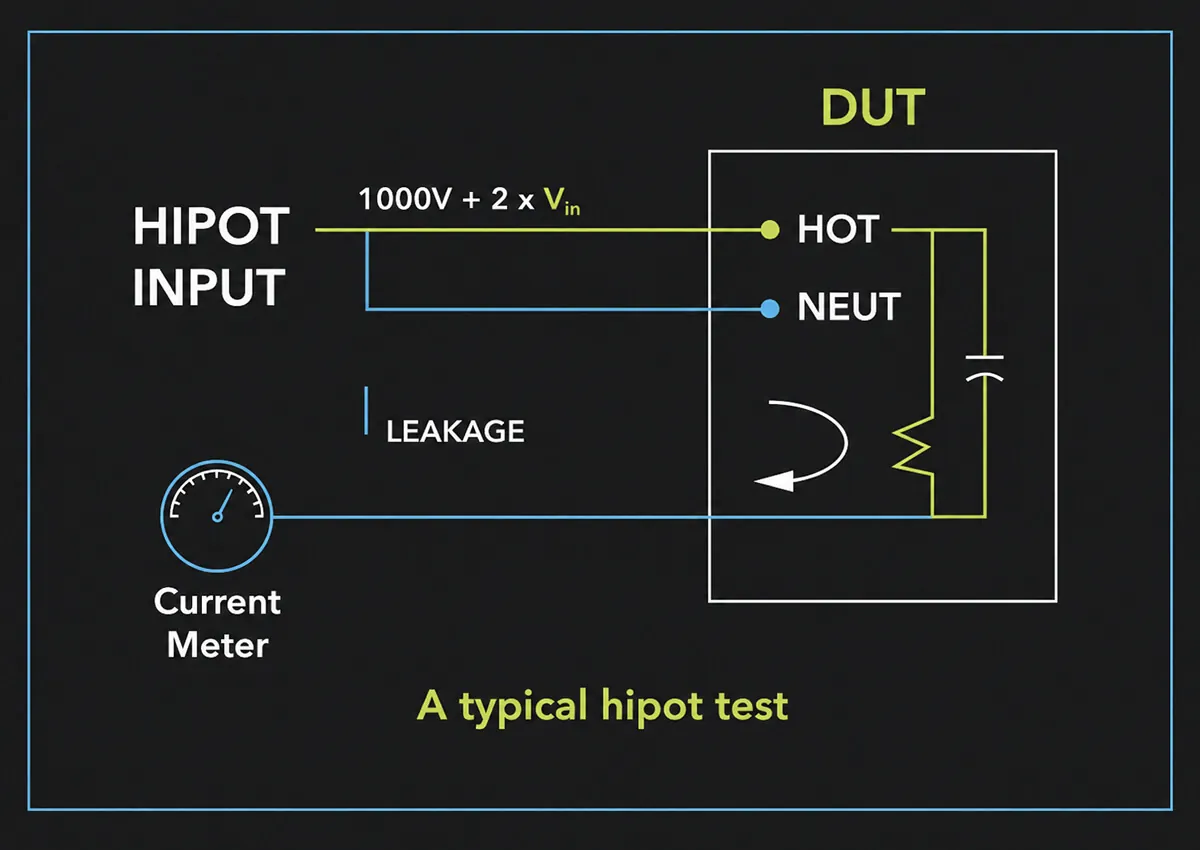
The AC hipot test is designed to test whether the product’s insulation provides safe isolation for a user who may be touching accessible conductive parts on the product chassis.
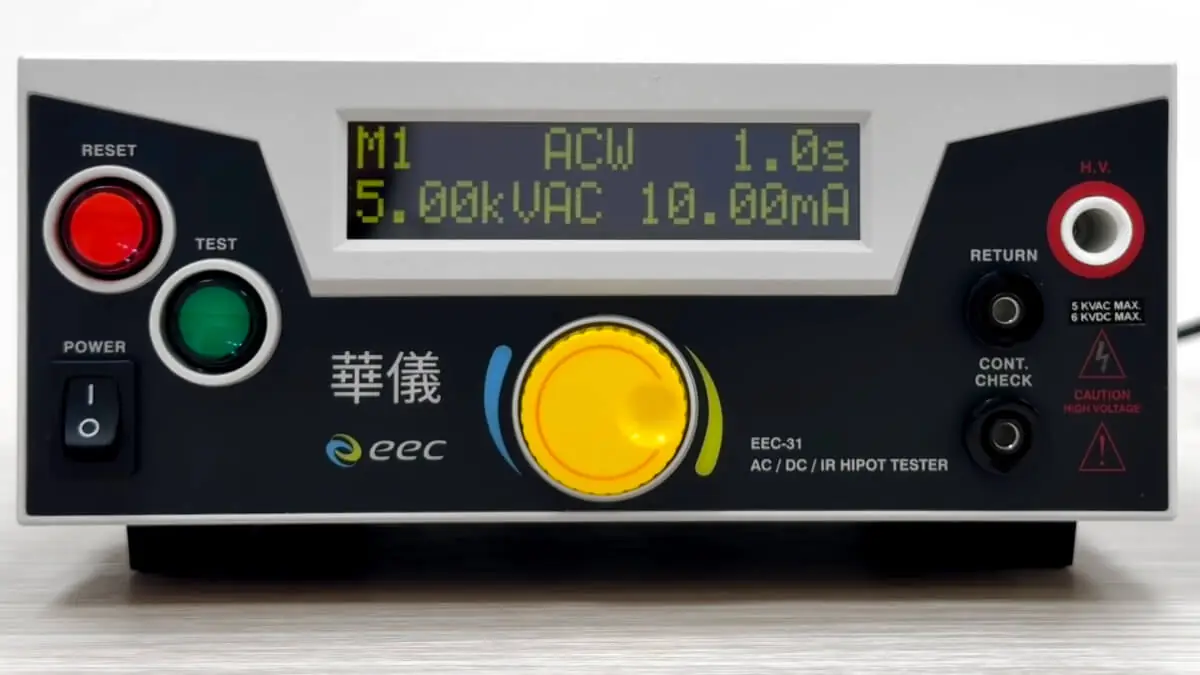
During the test one side is attached to the main circuit and the other to the chassis or grounded parts. The voltage places electrical stress on the insulation and reveals weak points where leakage current or breakdown may occur. At the failure point you will have current leakage on the grounded parts or an arc breaking through the insulation from the main circuit.
These are some key terms related to the test that you will need to know
- Test Voltage – This is the voltage defined by the testing standards and is usually scaled up from the devices normal operating voltage.
- Dwell Time – For design testing, the standard could be up to 60 seconds, for production line testing and to keep production lines running the test times are usually 1-2 seconds.
- Leakage Current – During the test you are monitoring the current as it leaks through the insulation or it crosses other isolation barriers.
- Capacitive Coupling – This occurs in things like heating elements where you always have capacitive charging currents, this is acceptable but resistive leakage or arcing would not be.
All of the values are defined in the testing standards such as IEC 62368-1:2023 which is used for most audio visual equipment. There is a more extensive list of common test standards for different types of equipment later in this article.
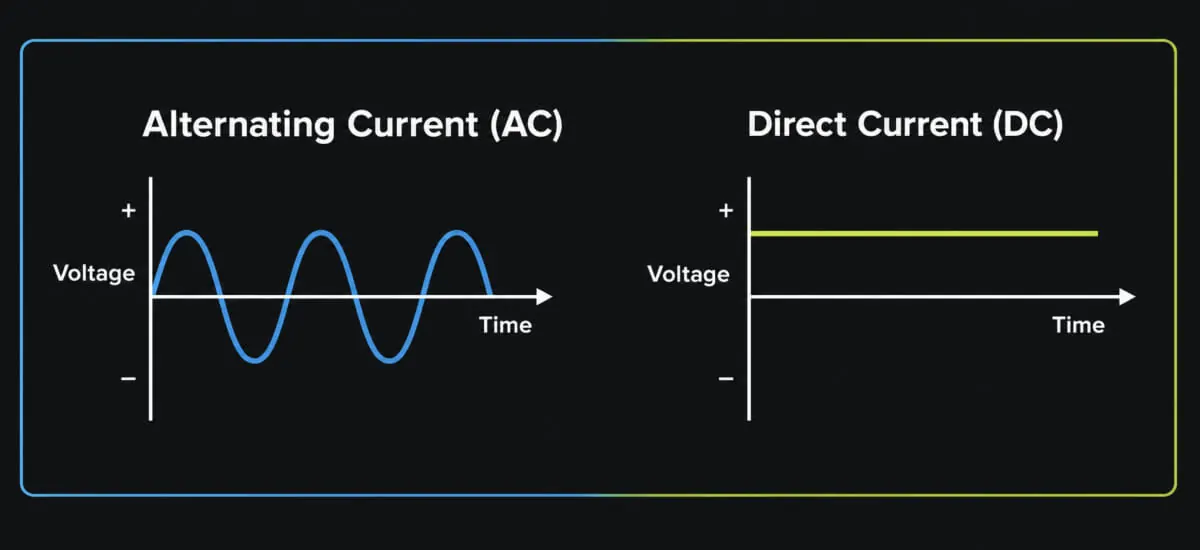
Do You Need DC Hipot Testing (DCW)?
There are two key factors that may determine whether your product is suitable for DC testing:
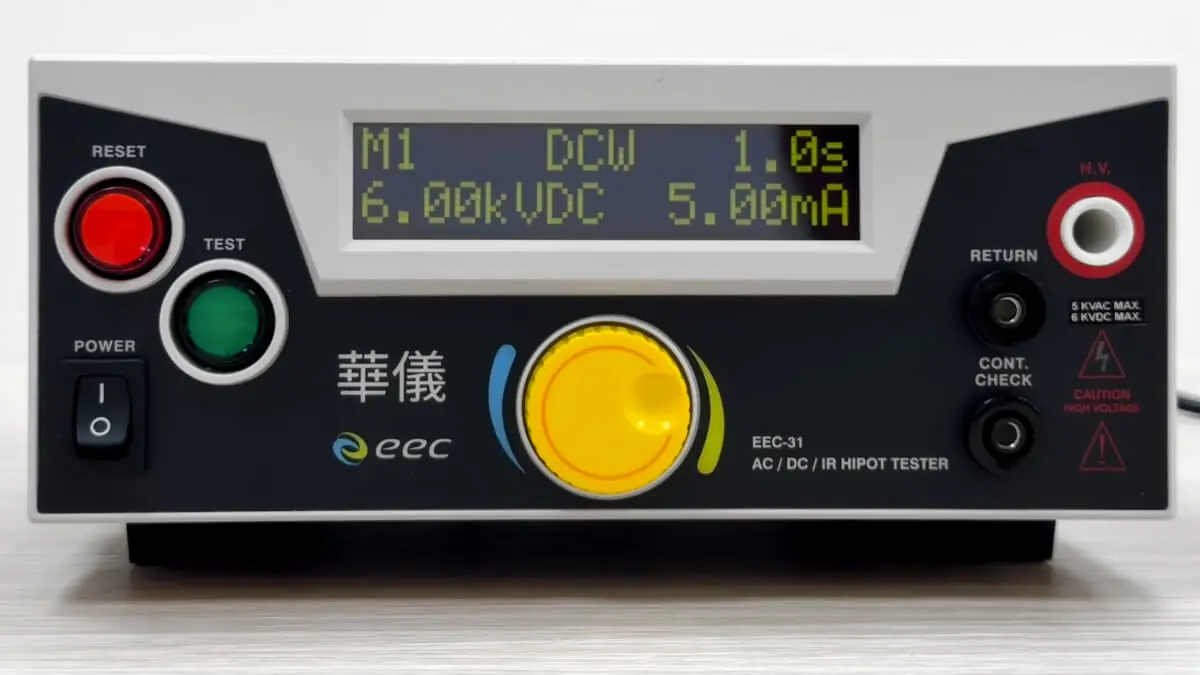
- Do the testing standards allow for DC testing and if so, you need to check the voltage as it will be different than for the AC test,
- Does your product have a capacitive nature (For example a heating element), if it does then a DC test may be more suitable and avoid false failures.
Advantages of AC Testing
ACW testing has some advantages over DCW:
- There is no ramp up time for the ACW test due to the change in polarity of the alternating current.
- In ACW there is no need to add extra time to avoid reactive current which could cause a false failure. This usually means that the test is much faster using ACW which is important for production lines.
- In ACW you are stressing the insulation in both polarities, from main to ground and ground to main, whereas in DCW you are only testing from main to ground.
- From a safety perspective in DCW you are left with a charged product at the end of the test so it is vital to have a procedure to discharge everything that was just tested. In ACW because you have the natural ramp up in voltage, it is not likely that you will see that full charge that would be left by a DCW test. Despite this it is best practice to make sure that you have a procedure to discharge the device after any hipot testing.
- The AC hipot test is also the most commonly accepted by testing agencies
When You Should Use a DCW Test
- The leakage current results you see on the test machine represent electrons breaking through from your main circuit through the insulation to your chassis, so this gives you the actual value that a customer might experience with your product in the field.
- With the ACW you have both reactive and real current so you cannot be sure if the current you are seeing is what the end user is going to see in the field. It could just as easily be a large reactive current added to the resistive current.
- DCW test machines require much lower current and are generally simpler machines with fewer features so they can be a bit cheaper than ACW test machines.
- If you have a product with a capacitive nature then you may need to use DC testing to avoid false failures.
Special Safety Note About Discharge:
Maximum capacitive loading is something that you need to check if you are going to run a DCW test as each test platform will have a value for this that you need to check. Our EEC Huayi products will discharge the product for you at the end of a test, but only up to the maximum capacitive loading value. If your testing value is higher than this value, you will need to have your own procedure to discharge the product at the end of the test. This ensures that on the production line you are not creating safety issues when the product passes through to the next cell in the process.
Insulation Resistance Testing (IR) – When Do You Need to Use it?
AC and DC hipot testing tells you whether insulation will fail under extreme voltage. Insulation resistance testing (IR) measures something different – the actual resistance value of the product’s insulation in mega ohms (MΩ).
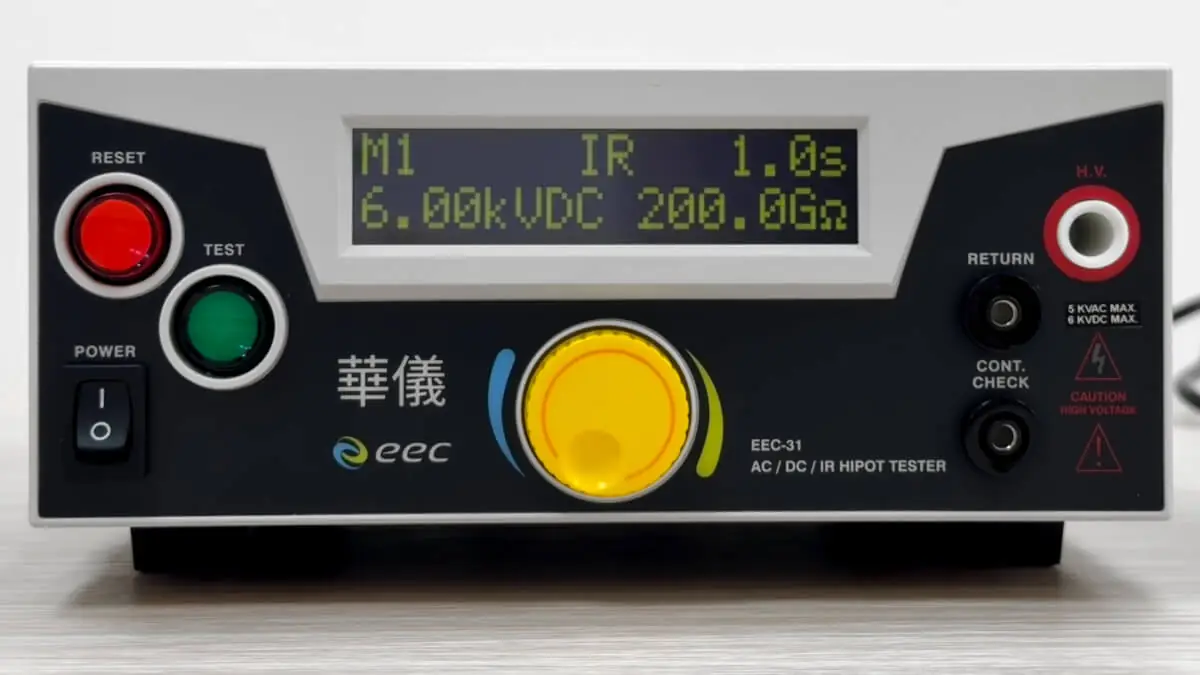
The IR test is very similar to the DCW test in terms of the connections. A voltage potential which is usually from 500-1000V is dropped across the insulation of the product. This results in a charging current which flows from the IR tester through the product’s insulation. When the insulation is fully charged, the only current that is flowing in the circuit is due to the resistance of the product’s insulation. This current is called the “real current”, and the resistance of the insulation is then calculated back from this to provide the resistance value in mega ohms (MΩ) using Ohms Law.
Most test standards require that the test be performed for around 60 seconds and that the resistance of the product should not fall to below 1-4 MΩ. The test procedure is very similar to the DCW test: the machine to be tested is plugged into the tester, the return circuit is completed by attaching the cable to a point on the chassis. As with the DCW test, the voltage ramps up and we are looking to make sure that the insulation has sufficient resistance and does not fall below the required value (1-4 MΩ).
Where IR testing is especially important:
- Battery management systems, EV components, where high-resistance verification is a documented compliance need.
- Medical devices, where insulation degradation over time is a safety-critical concern
- Motors, transformers, and other devices with winding insulation that ages under heat and load cycles.
- Repair shops where they need to verify the integrity of insulation on repaired products.
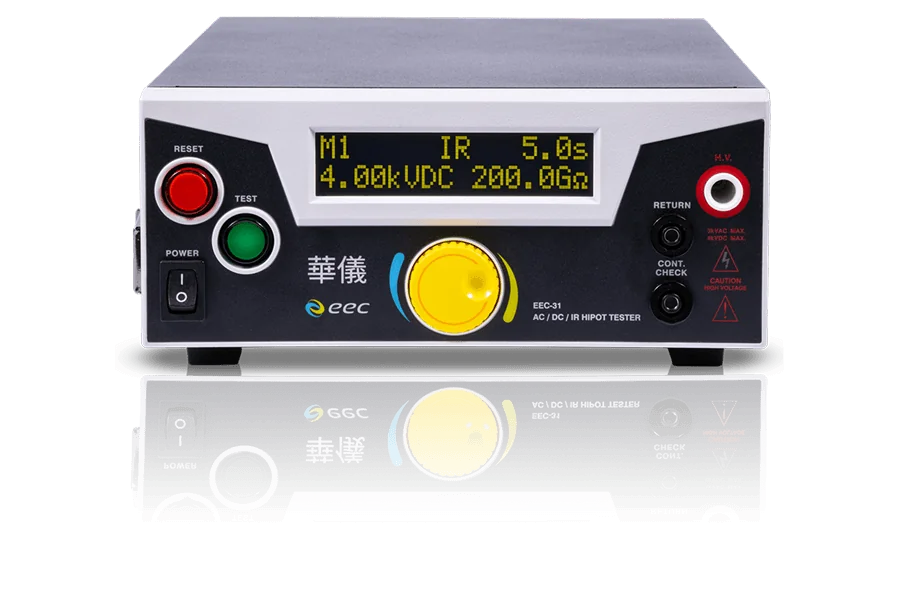
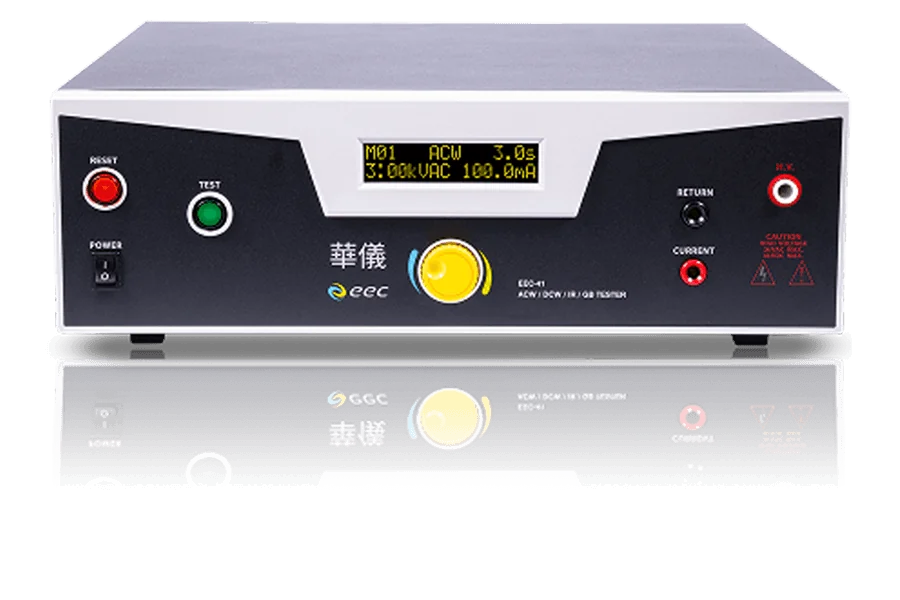
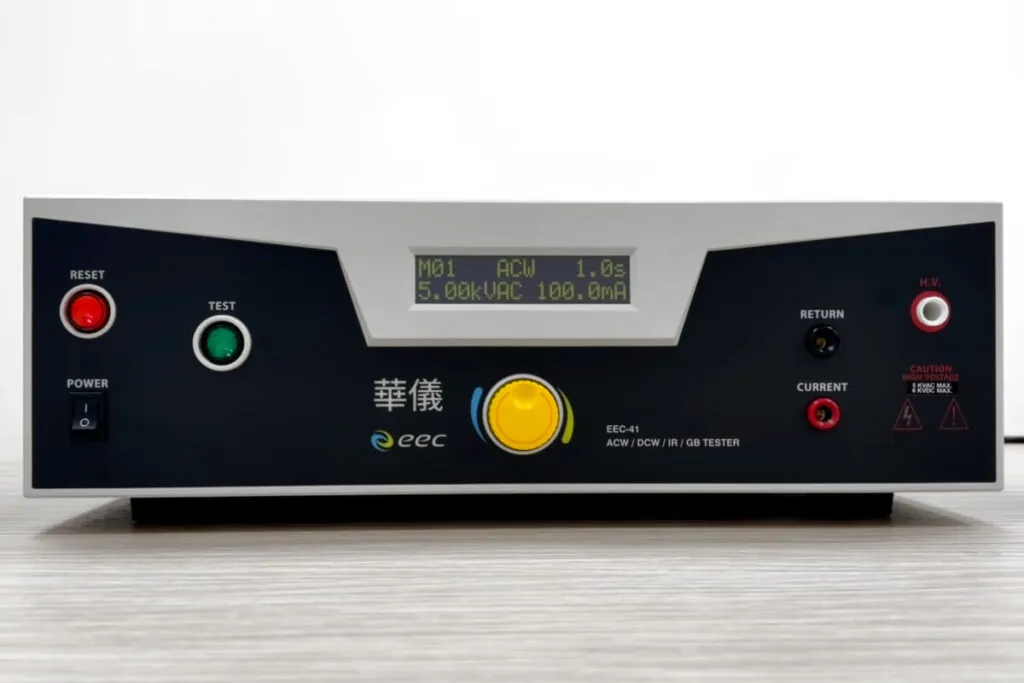
The EEC-31 AC/DC hipot tester runs IR testing up to 4 kV at 200 GΩ.. That upper range matters for component and battery manufacturers whose certification needs call for high-resistance confirmation rather than a basic pass/fail leakage check. The EEC-41 runs IR at up to 1 kV and 1,000 MΩ.
Which Test Does Your Safety Standard Need?
Most of the time, your certification agency’s test specification answers this question directly. When it does not, the table below covers the most common standards for EEC Huayi’s primary industry segments. No matter what testing standards you receive from a customer, you should always verify these against the documented standard to ensure the values to be tested are in compliance with them.
| Safety Standard | Product Category | ACW Hipot | DCW Hipot | Insulation Resistance (IR) | Notes | Source |
|---|---|---|---|---|---|---|
| IEC 62368-1:2023 | IT, AV, and communication equipment | Required (type test) | Permitted (DC = ACW x 1.414) | Required for reinforced/double insulation | Replaced IEC 60950-1 in December 2020. DC accepted an equivalent test. | https://webstore.iec.ch/en/publication/69308 |
| IEC 60335-1:2020 | Household and similar appliances | Required (type and routine test) | Permitted (DC = ACW x 1.414) | Required after humidity treatment | Covers appliances, HVAC, lighting. IR typically tested at 500 VDC. | https://webstore.iec.ch/en/publication/61880 |
| IEC 60601-1 | Medical electrical equipment | Required | Permitted with 1.414x voltage adjustment | Required for patient-applied parts | DC accepted with voltage adjustment. IR critical for leakage compliance. | https://webstore.iec.ch/en/publication/2606 |
| IEC 61010-1 | Measurement, control, and lab equipment | Required | Permitted (DC = ACW x 1.414) | Required for mains-circuit insulation | Also covers test and measurement equipment. | https://webstore.iec.ch/en/publication/4279 |
| GB 4943.1-2022 | IT equipment (China market) | Required | Permitted (DC = ACW x 1.414) | Required for reinforced insulation | Issued by SAMR/SAC. Harmonized with IEC 62368-1:2018 (MOD). | https://www.sac.gov.cn/Standards/art/2022/art_b5d351bd4aa94c8f8cde1973d1eb47d0.html |
| IEC 60950-1:2005 (legacy) | Legacy IT equipment | Required | Permitted | Required | Superseded by IEC 62368-1 in December 2020. Still referenced in some legacy certifications. | https://webstore.iec.ch/en/publication/4020 |
| IEC 60204-1:2016 | Industrial machinery electrical equipment | Required (1000V + 2x rated, min 1s) | Permitted | Required (min 1 MOhm at 500 VDC) | Routine test for machine builders. | https://webstore.iec.ch/en/publication/26037 |
Frequently Asked Questions
What is the difference between AC hipot and DC hipot testing?
AC hipot testing uses alternating voltage. DC hipot testing uses steady unidirectional voltage. AC testing is the default method for most products and is widely accepted by certification agencies. DC testing gives a cleaner reading of true resistive leakage current because it removes the reactive current caused by capacitance. DC testing is also the only valid option for components that include diodes or rectifier circuits, which cannot tolerate AC polarity reversal.
When is insulation resistance testing needed?
Insulation resistance testing measures how degraded insulation already is under normal conditions. It applies a lower DC voltage — typically 500 V to 1,000 V — and measures insulation resistance in megohms or gigohms. Some standards need IR to run before the hipot test as a pre-screen. Others need it after, to confirm the high-voltage test did not degrade the insulation it was meant to check. IR testing is especially important for battery management systems, EV components, medical devices, and motors or transformers where insulation ages under heat and load.
Which IEC standard needs AC hipot testing for IT equipment?
IEC 62368-1:2023 is the current standard for IT and audio-visual equipment. It replaced IEC 60950-1 in December 2020 and uses AC hipot as the primary dielectric withstand method.
Can a multi-function tester replace separate AC and DC hipot testers?
Yes. A 3-in-1 or 4-in-1 tester covers ACW, DCW, and IR in a single unit. You are not committing to one method at the time of purchase. If your certification needs change or a new product line needs a different test type, the unit already supports it.
Does the EEC-31 support both AC and DC withstand testing?
Yes. The EEC-31 covers AC withstand (ACW), DC withstand (DCW), and insulation resistance (IR) in one unit, tested to 3 kV AC, 4 kV DC, and 4 kV IR at 200 GOhm. The EEC-41 adds ground bond (GB) testing for manufacturers who need to check protective earth integrity as part of the same test sequence.
Why Multi-Function Testers Solve the Method Selection Problem
For many manufacturers, the answer to “AC, DC, or IR?” is all three. Product lines change. Certification needs change. A manufacturer who buys an AC-only tester today may need to buy a second unit within two years when a new product line needs IR testing or their agency issues updated test requirements.
A 3-in-1 or 4-in-1 tester removes that risk at the point of purchase. You are not committing to a single method, you are buying coverage for now and the future.
The EEC-31 covers ACW, DCW, and IR in a single unit, CE certified and IEC compliant. The EEC-41 adds ground bond (GB) testing for manufacturers who need to check protective earth integrity as part of the same test sequence. Both models support PLC remote control and are backed by professional calibration services through our service locations in Asia which keeps units accurate without needing overseas shipment.
For more information about our new EEC-Huayi Products, please contact us.