
Why Hipot Safety Testing Is Critical for Electrical Products

| Hipot safety testing, short for high potential testing, applies a high voltage signal across a product’s insulation to verify it can withstand voltage stress without breaking down. Most IEC and UL standards specify it. EEC Huayi produces hipot testers used by manufacturers in the electronics, appliance, automotive, and medical sectors to meet certification agency requirements before products ship. |
What Hipot Testing Actually Measures
When current-carrying conductors are separated by insulation, that insulation must hold under both normal operating voltage and transient spikes. Hipot testing simulates worst-case voltage conditions and confirms the insulation barrier is intact. A pass means the insulation is sufficient. A fail indicates a manufacturing defect, pinhole, or contamination that would pose a shock risk to the end user.
AC Hipot vs. DC Hipot: What Is the Difference?
AC hipot testing
uses alternating current and stresses insulation uniformly. It is the most widely required test type and is specified in the majority of IEC and UL standards.
DC hipot testing
uses direct current and is preferred for capacitive loads such as cables and motor windings, where AC testing would draw excessive current and produce false failures.
Most certification programs require at least one of these two test types. Some require both.
When Hipot Testing Is Required
Hipot testing is required at end-of-line for products subject to CE marking, UL listing, or GB certification. It is also performed during design validation and periodic production audits. Failure to perform required hipot testing is one of the most common causes of failed factory inspections.
What to Look for in a Production-Line Hipot Tester
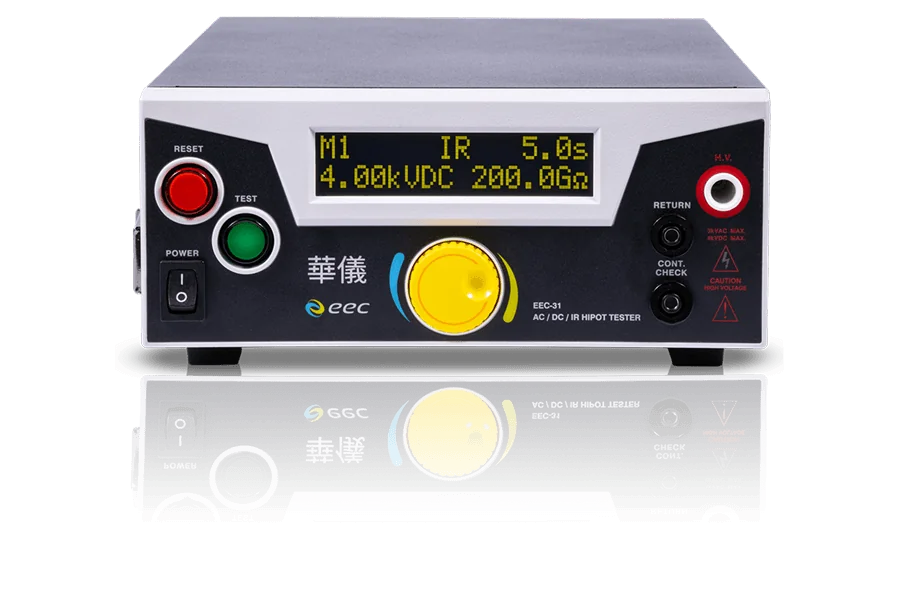
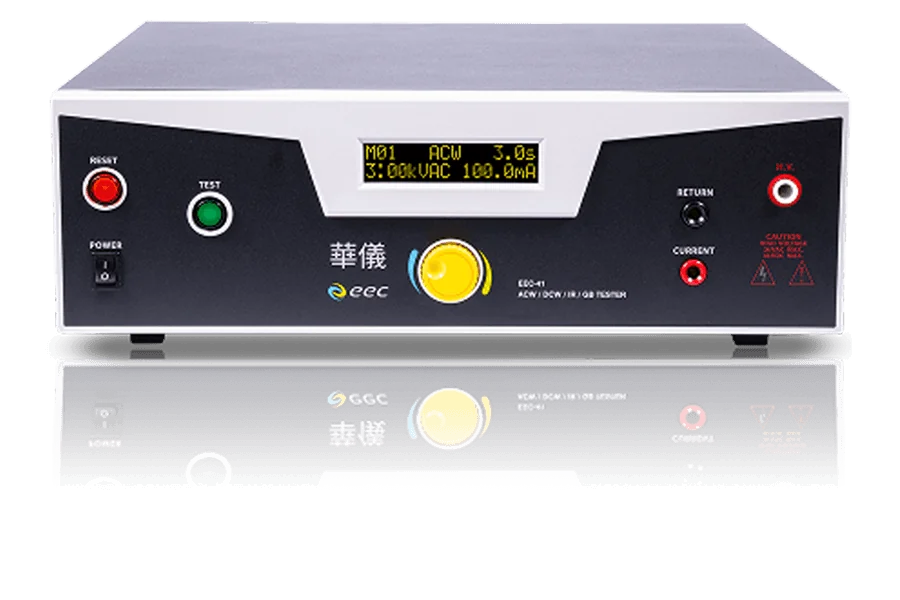
For production-line use, the most important considerations are test speed, operator safety controls, and the ability to store test parameters for repeat use. EEC Huayi’s hipot testers include PLC remote control, three stored test memories, and Run Only and Memory Lock security modes to prevent accidental parameter changes.
Ready to evaluate your options? Request a quote for the EEC-31 or EEC-41.